Of Children’s Toys
Based on the philosophical parables „Tales from Lailonia Kingdom for the Big and Small” by Leszek Kołakowski.
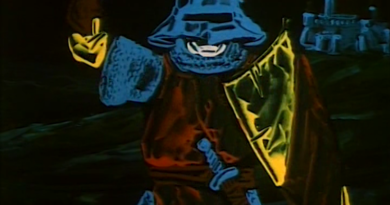
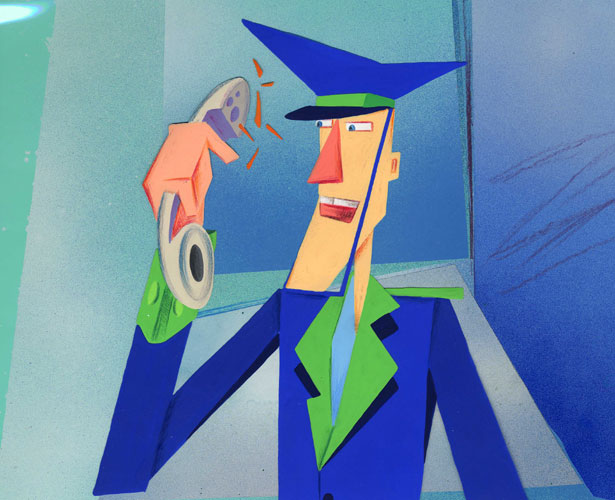
Pigu, a merchant, lives with Memi, his daughter, in the kingdom of Lailonia. As the favourite pastime in this country is puncturing globes, Pigu always brings Memi a new globe from his absence Memi orders a globe the size of Earth. When Pigu sends it back to the shop the shop the girl becomes hysterical. Not knowing what to do Pigu tells Memi that she could try puncturing the Earth itself. The results of this are tragic. Pigu is sent to prison. Alone in his cell he concludes that people should not skimp money on toys for their children.


O ZABAWKACH DLA DZIECI (OF CHILDREN’S TOYS)
Directed, artwork by Hieronim Neumann
Script, dialogue by Jan Zamojski
Music and performed by Krzesimir Dębski
Layout by Maciej Matecki
Animation by Maciej Matecki, Janusz Gałązkowski, Ewa Rodewald, Agnieszka Szcześniak, Elżbieta Kandziora, Waldemar Szajkowski
Dubbing directed by Ewa Złotowska
Dubbing: Zbigniew Zapasiewicz – Narrator, Ewa Złotowska – Memi, Marek Frąckowiak – Pigu
Camera by Zbigniew Kotecki, Jadwiga Zauder
Editing by Teresa Miziołek
Sound by Wiesław Nowak
Production Manager by Ewa Samborska
Series executive director by Maciej Wojtyszko
Series editor by Anna M. Zaremba (TV SFA)
Series Editor by Krystyna Chojnicka (TVP S.A.)
The film made in the classical animation on celluloid, 35 mm, colour, 408 m, 14:55 min.
Production date: 19.03.1999
© TVSFA-TVP SA 1999
TITLE SEQUENCE
Script, direction, design, animation by Piotr Dumała
Music by Bernard Kawka
Camera by Jan Maciej Ptasiński
Editing and sound by Wiesław Nowak
35 mm, colour, 27 m, 01:00 min., Year of production: 1996
Premiere: 24.04.1999 r. OFF „Ale Kino!” in Poznań
Awards:
PHILIP AWARD’ NOMINATION to Krzesimir Dębski in the category “The best music specially composed for a Polish animation film”, TP SA Music & Film Festival, Warsaw, Poland, 2000
HONORARY DIPLOMA for the work and assistance in and a warm-hearted and friendly attitude to the implementation of the Foundation’s tasks, ‘Promotion Academy’ Foundation Warsaw, Poland, 2000
MARCIN CHILDRENS’ JURY AWARD, for the best picture: The film enchants with its grotesque vision of modern times, its original concept of showing the everyday toils of the inhabitants of Lailonia who are a spitting image of people from Earth, National Competition, 17th International Festival of Films for Children Ale kino!, Poznań, Poland, 1999
DIPLOMA for the film direction, International Festival of Animated Films for Children – Biennial of Animation BAB’99, Bratislava, Slovakia, 1999
===================================================
A STORY ABOUT CHILDREN’S TOYS, a film OF CHILDREN’S TOYS,
or how even in love one should never confuse fiction with reality…
Essay – Jan Zamojski
The Russian and American writer Vladimir Nabokov appealed to parents to spoil their children, because one never knows what life has in store for them. This view seems to have prevailed and is widely shared today. I must admit that I don’t know if Leszek Kołakowski was familiar with it, though it is highly probable. Regardless, the fact remains that when this view was not yet so fashionable (though everything was already moving towards it), Leszek Kołakowski enriched this topic with his A Story About Children’s Toys. To the unknown future of children, which Nabokov spoke of, through another fairy tale from Lailonia, he added a question that had eluded the brilliant bilingual writer (and not only him): what else awaits spoiling parents in life? If we are to believe the philosopher, this time – it is rather obvious, and it is not something pleasant, at least in Lailonia.
This brings us to the first and most visible aspect of “A Story of Children’s Toys” (as well as the film with a slightly shorter title): the pedagogical aspect. Or, more precisely, if we want to get even a little closer to the spirit of this work, two aspects: koreogic (kore is Greek for girl; after all, Memi is a girl, not a boy; I invented the term myself) and andragogic (referring to the upbringing of adults, and the merchant Pigu is a very adult; the term functions in science). We will return to semantic matters, or matters concerning meanings, later.
Pigu certainly didn’t have time for Memi; busy making money, he tried to soothe his conscience by giving her increasingly expensive gifts. But was he willing to fulfill her every whim? Not either. It would have cost him too much, and if he had gone into debt, he would no longer have been able to shower his daughter with gifts; it’s safe to assume that this would have led to more than just one argument. In essence, due to his own neglected upbringing (and perhaps—let’s not be too harsh on Pigu—due to some misfortune, as we know nothing about Memi’s mother, who could also have contributed to raising his daughter), Pigu put himself in an impossible situation: by buying a life-size globe, he would have gone into debt and, as a result, exposed Memi (who knows what and how expensive her next whim would be). By not buying it, he only exposed himself but probably lost his nerve and health because of her sobs. By offering Memi the globe, he effectively condemned himself to both debt and prison. Wanting to avoid the bankruptcy that would have befallen him in the first case, he actually accelerated it. Moreover, it seems he hasn’t learned anything from his situation, as he now sits in prison and thinks it’s best not to skimp on children’s toys, which simply means he should have bought the life-size globe Memi ordered. These are all very easy to deduce from both the fairy tale and the film. The question remains: why did Pigu, who wasn’t stupid, act the way he did? What was he hoping for?
And here we return to semantics.
I know from experience how much readers and viewers find the meanings of the names Pigu and Memi amusing; it seems absurd to us that words of only two syllables can have such complex referents (that is, real-life equivalents). While these are Old Lailonian terms, we have reason to believe that the situation is even worse in New Lailonian. Furthermore, the Lailonians and Babylonians there behave in a way that today we might call a consumption frenzy: they buy useless things just to accumulate as many as possible.
It seems that a characteristic of such communities is precisely finding concepts for equivalents that are the largest and strongest possible sum of specific features, but not abstract. I once heard a mocking song by a band about someone buying a “black tractor to haul her around.” I was curious what that was. It turned out to be something consisting of (I may not remember it exactly, but that’s the gist of it): alloy wheels, a sunroof, air conditioning, and many other things, such as the fact that a black tractor has a powerful kick. The word “car” was never mentioned once.
Issues related to language occupy a significant place in philosophy. If one were to search for them in Leszek Kołakowski’s work, they would probably be most present in his book “Positivist Philosophy (from Hume to the Vienna Circle). They require greater concentration, so let’s at least consider the famous statement by Ludwig Wittgenstein, a philosopher associated with this movement, cited there by the author: “The limits of my language are the limits of my world.” Pigu’s world would therefore be a sum of camel combs, small pink elephants without ears, instruments for punching holes in globes, etc., etc. Where one began to speak more abstractly, for example, about a life-size globe, Pigu’s world would end.
But that’s half the story. Furthermore, this world has little in common with reality (today we’d probably say it’s virtual), and therefore, the merchant Pigu struggles with the criterion of truth. For example, he calls the globe a real globe. Based on Latin and semantically speaking, in the context of interest to us here, we must state that globus literally means a sphere, as well as (globus terrae) – the globe itself, but also a model of it. And in Pigu’s world, the equivalents of concepts, though extremely complex and complicated, were, after all, very specific, singular. Here, however, we are dealing with a situation where one concept has three equivalents (and in fact, the word “globus” has many more, e.g., globus hystericus, which Memi seems to have been drawn to after her father’s initial refusal). So, either this problem transcended the world of Pigu the merchant and he got confused with the globe, or, more likely, he was counting on the fact that since the Earth is also a globe, no one would object; as we know, globes are for making holes. Memi’s behavior, which is the result of this very approach on Pigu’s part, although logical in the Lailonian order, seems to make no sense to us.
And so, it goes. It’s better to stick to the humanist concept of meaning. Then it becomes clear that destroying models or forgeries cannot be transferred to the original with impunity. So much for the globe, but what about truth, love, or happiness?
PS. I don’t need to add that if Wittgenstein is right, then for everyone who wrote or said anything on this matter: Master Kołakowski, the film’s director Hieronim Neumann, Pigu, Memi, (and myself as well) the limits of their language are the limits of their world. Therefore, it follows perhaps most powerfully that matters related to this fairy tale may be completely different from what you may have read, seen, or heard.
© 2010 AnimaFilm & Jan Zamojski
All rights to Jan Zamojski’s essays reserved by the AnimaFilm Film Art and Education Foundation and the Author. Copying and using without the consent of the is prohibited.